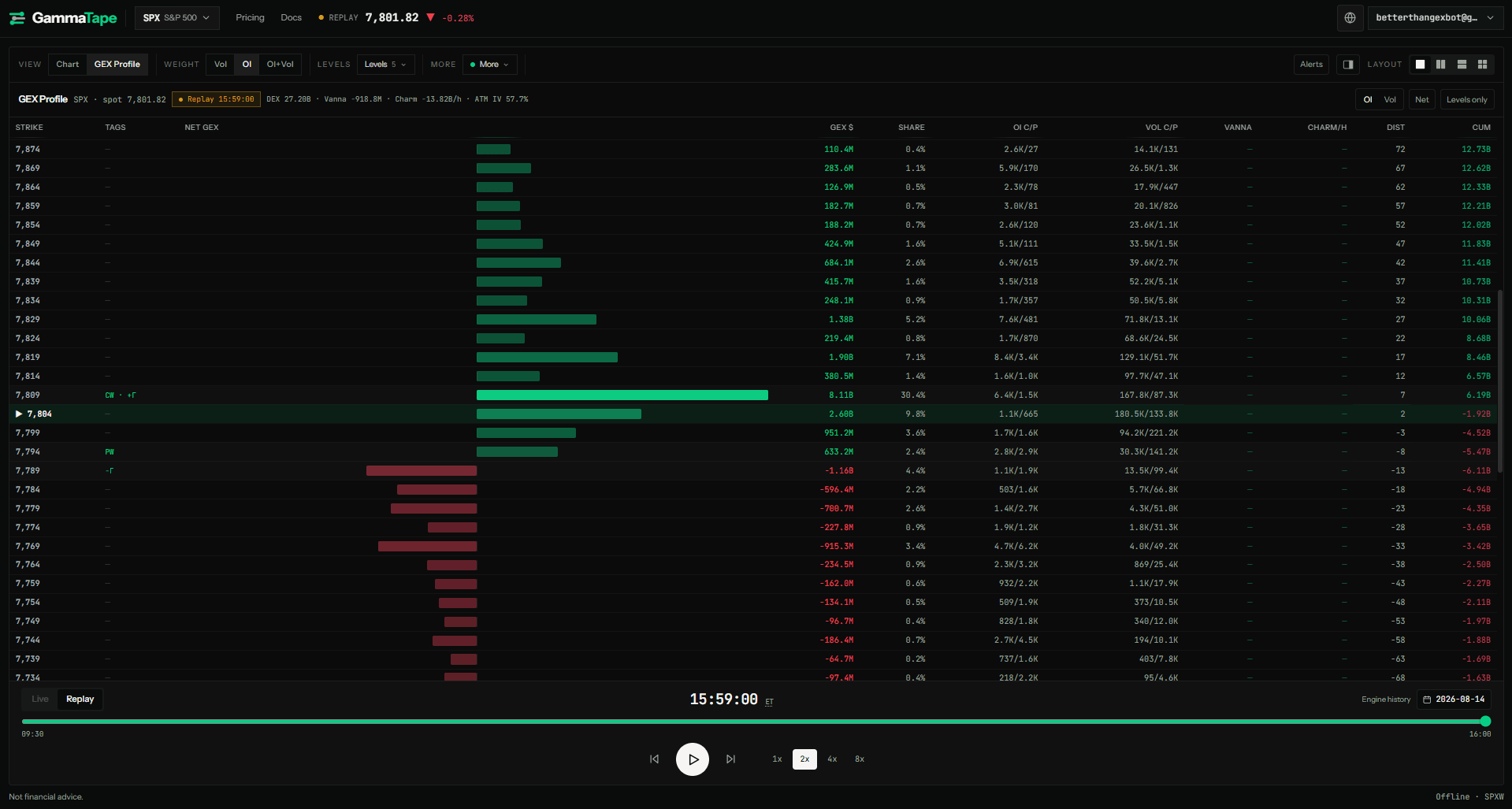
Open the OI+Vol compare view and you will often see a clean volume ladder next to an OI ladder full of “0”s a few strikes away from spot. That looks broken the first time. It usually isn’t.
What the profile is actually plotting
Each strike row shows signed net gamma exposure under the selected weight. Volume GEX uses today’s traded size; OI GEX uses standing open interest. The strike grid is shared across both books so you can compare the same prices side by side — including strikes that only one book cares about.
- Volume can light up a strike that barely existed in OI this morning (fresh 0DTE flow).
- OI can stay near zero on far OTM strikes where almost nobody left overnight inventory.
- Call and put OI gamma can cancel at a strike → net OI GEX ≈ 0 even when both sides are “alive.”
When a zero is normal
- Far from spot on a quiet OI book — expected on SPX/NDX wide grids and on ETF chains with sparse OTM inventory.
- Early session before OI updates catch up with the open — volume leads; OI lags.
- Net-zero straddles — both sides have gamma, signed sum rounds to 0 (the bar may still be hairline-thin).
When to dig deeper
Worry less about scattered 0s and more about structure: if near-the-money OI GEX is blank while volume and the live chain look active, refresh the session or check connectivity. A healthy book still shows large OI GEX clustered around spot and the main walls — zeros live in the wings.
Related
- Volume vs OI GEX → /blog/volume-gex-vs-oi-gex
- What is GEX? → /blog/what-is-gamma-exposure-gex