Open a 0DTE GEX ladder and you will often see two versions of the truth: one weighted by volume, one by open interest (OI). On quiet days they rhyme. On active days they argue — and that argument is useful.
What each weighting answers
- OI GEX — where the existing book still sits. It answers: “What positioning was already on before today’s flow?”
- Volume GEX — where today’s traded contracts are rewriting exposure. It answers: “What is the tape building right now?”
OI is stock; volume is flow. Traders who only watch one miss half the map.
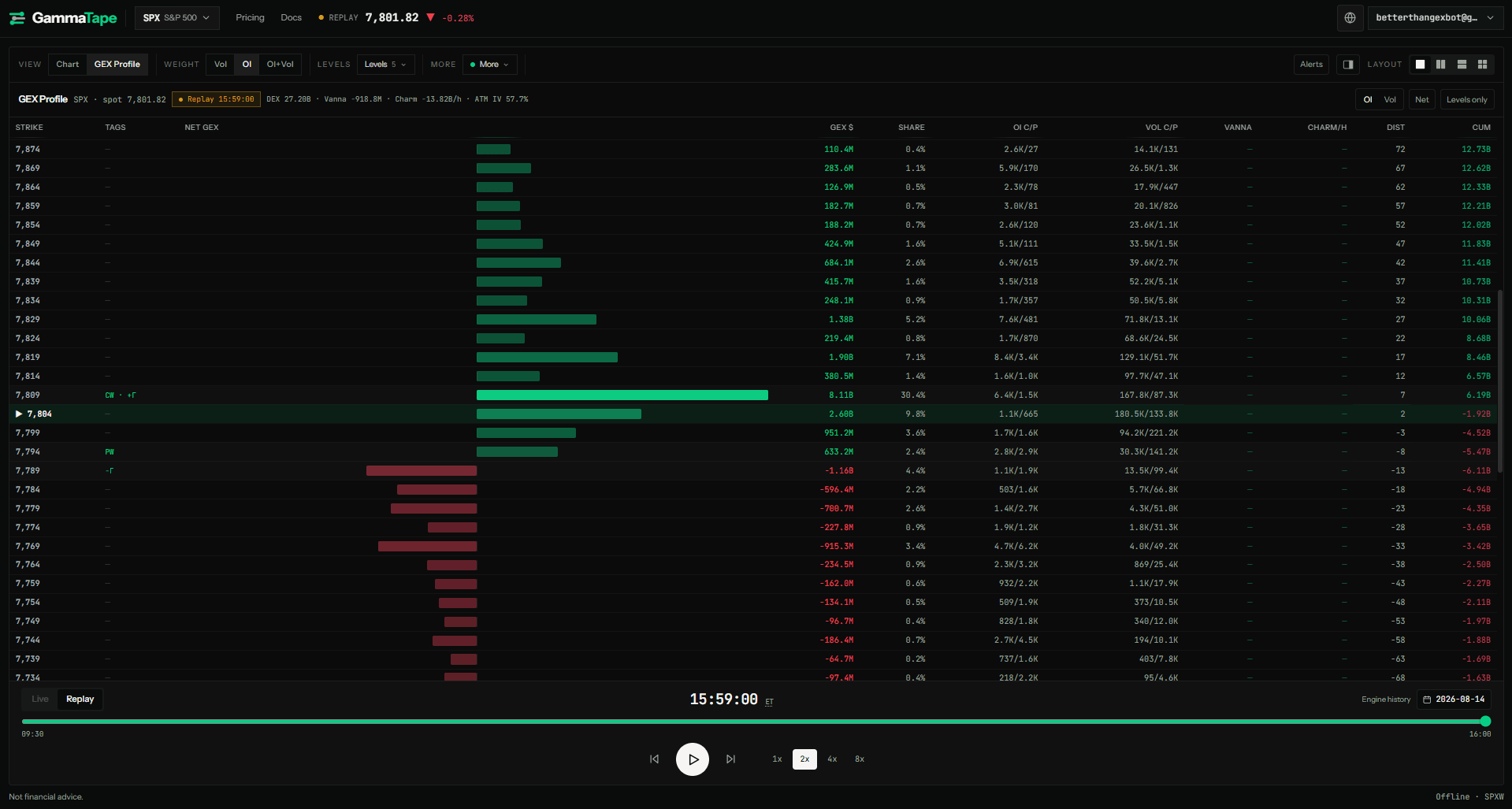
How to read a disagreement
When volume GEX flips negative around a strike that still shows positive OI GEX, the session is often chewing through a prior pin. Dealers’ residual OI still says “dampen,” but fresh volume says “amplify.” The opposite pattern — volume building a green wall where OI was quiet — can mark a new magnet forming for the afternoon.
- Start with OI for the structural map (walls, major long/short gamma).
- Watch volume for regime changes and strike-by-strike aggression.
- Use the combined OI+Vol view when you want a single blended ladder, then verify with the split.
- Re-check after large prints — 0DTE books rewrite quickly.
Practical checklist for ES / NQ
- If futures are leaning into a put wall on OI but volume GEX is already deeply short gamma there, treat that wall as softer than the OI chart alone suggests.
- If volume piles positive gamma just above spot while OI is flat, that strike can become the afternoon magnet even if it was invisible at the open.
- Net GEX totals summarise the regime — but the shape by strike is what you trade against.
Related
- What is GEX? → /blog/what-is-gamma-exposure-gex
- Call/put walls on the chart → /blog/reading-0dte-walls-on-the-chart